
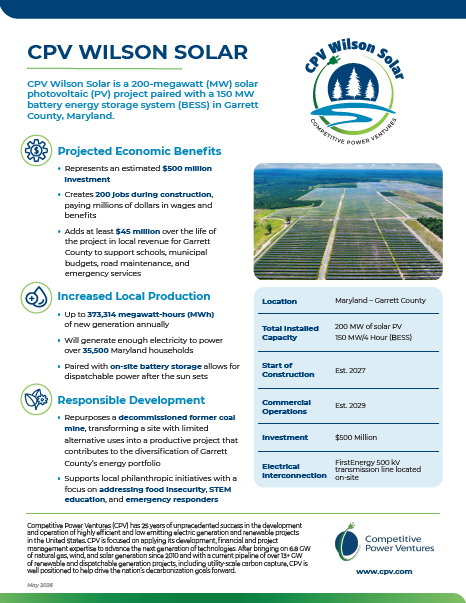
CPV Wilson Solar
Project Quick Facts
Location: Garrett County, MD
Status: In Development
Total Installed Capacity: 200 MW of Solar and 150 MW/4 Hour BESS
System Information: Solar Photovoltaic (PV) and Battery Energy Storage System (BESS)
Est. Construction Start: Q1 2027
200+
Construction Jobs
$500 Million +
Investment
31,658
Equivalent Cars Off the Road
Project Overview
The CPV Wilson Solar Project is a proposed 200-megawatt (MW) photovoltaic (PV) solar farm with a 150 MW/4-hour battery energy storage system (BESS) located in Garrett County, Maryland. The project will create a new source of clean, renewable energy for the region while improving the grid’s energy reliability. Once operational, CPV Wilson Solar will produce up to 373,314 megawatt-hours (MWh) annually which is enough to power over 35,500 average Maryland households.
Co-location of solar and BESS means pairing a solar generation facility and storage system on the same site to allow excess solar energy to be stored and dispatched later when it is most needed.
CPV Wilson Solar will hold two public information meetings on October 21 and 22 from 5:00-7:00pm. The meetings will take place at the Pleasant Valley Community Center (975 Joni Miller Rd, Oakland, MD 21550). All are welcome to attend.
Community Benefits
- Adds up to $85 million over the life of the project in local revenue for Garrett County to support schools, municipal budgets, road maintenance, and emergency services.
- Major private infrastructure investment of over $500 million.
- Creates approximately 200 jobs during the construction phase (14-18 months). Local firms and individuals will be engaged for engineering, surveying, site preparation, and construction. Inspection and maintenance during operation will also create jobs locally.
Environmental Benefits
- Repurposes a former coal mine site, transforming a site with limited alternative uses into a productive energy generating asset, while also contributing to the diversification of Garrett County’s energy sources.
- Expands renewable resources, sustains local environmental quality, and helps drive decarbonization efforts.
Project Resources
Documents
There are no documents to view at this time.
Frequently Asked Questions
CPV Wilson Solar is an 200 MW solar power and 150 MW/4 Hour BESS generation facility in Garrett County, Maryland.
The community benefits from CPV Wilson Solar as it adds new tax revenue to the area supporting community causes and benefits. Additionally, over the life of CPV Wilson, there will be significant direct and indirect economic benefits from the ongoing operation and regular maintenance of the facility.
Co-location of solar and battery energy storage systems (BESS) means pairing a solar generation facility and BESS on the same site to allow excess solar energy to be stored and dispatched later when it is most needed.
There is a plan to decommission the project at the end of its operation. This plan ensures that solar panels are sent to regionally certified recycling facilities for deconstruction and reuse, promoting responsible resource management.
The battery system will be decommissioned in compliance with the conditions outlined in CPV Wilson Solar’s Certificate of Public Convenience and Necessity (CPCN).
Solar panels are designed to be safe for the environment. The materials used in solar panels are non-volatile and encased in tempered glass, which prevents chemical releases. Additionally, solar panels do not contain any liquid which could leak in the event of damage.
Safety is a top priority for CPV. Modern battery energy storage systems (BESS) are designed with multiple layers of protection, including advanced monitoring systems, built-in safeguards at the cell and system level, and rigorous testing requirements. These features work together to prevent issues and ensure that, in the unlikely event of a problem, it is quickly identified and contained. CPV works closely with local fire departments to ensure clear emergency response planning is in place.
No. Battery storage facilities are designed to operate safely without placing additional burden on local emergency services. CPV coordinates with local first responders to provide training and share project-specific safety information so they are well-prepared, in the unlikely event of an emergency. These proactive measures help ensure an efficient response, even though incidents are highly unlikely.
Photos
There are no photos to view at this time.